
Port 2049 sits open on file servers, NAS appliances, build farms and Kubernetes storage nodes. Since 2014, the Linux kernel listening on it has let anyone who can reach it write into kernel memory before logging in. We pointed OpenSec's Antara at it. It came back with a root shell.
Pre-auth heap overflow in the Linux NFS server (nfsd)
Fixed in Linux 6.12.117, 6.18.61, 7.3.2 and 7.4-rc1. Update the kernel and reboot.
What you need to know
- What: a pre-auth heap overflow in the kernel's NFS server,
nfsd. - Who: any Linux host serving NFSv4.1 or 4.2 (the default) on a reachable tcp/2049.
- Impact: one TCP connection writes 61 bytes past a kernel heap object; chained, that gives a root shell.
- Now: patch and reboot. Until then, firewall tcp/2049.
Key facts
- Severity 9.8 Critical (AV:N/AC:L/PR:N/UI:N)
- Attack Remote, unauthenticated, tcp/2049
- Impact Kernel heap overflow → remote root shell
- Bug age 12 years, since Linux 3.16 (2014)
- Affected In-kernel nfsd with NFSv4.1 or 4.2
- Fixed in 6.12.117 · 6.18.61 · 7.3.2 · 7.4-rc1
One connection, no login
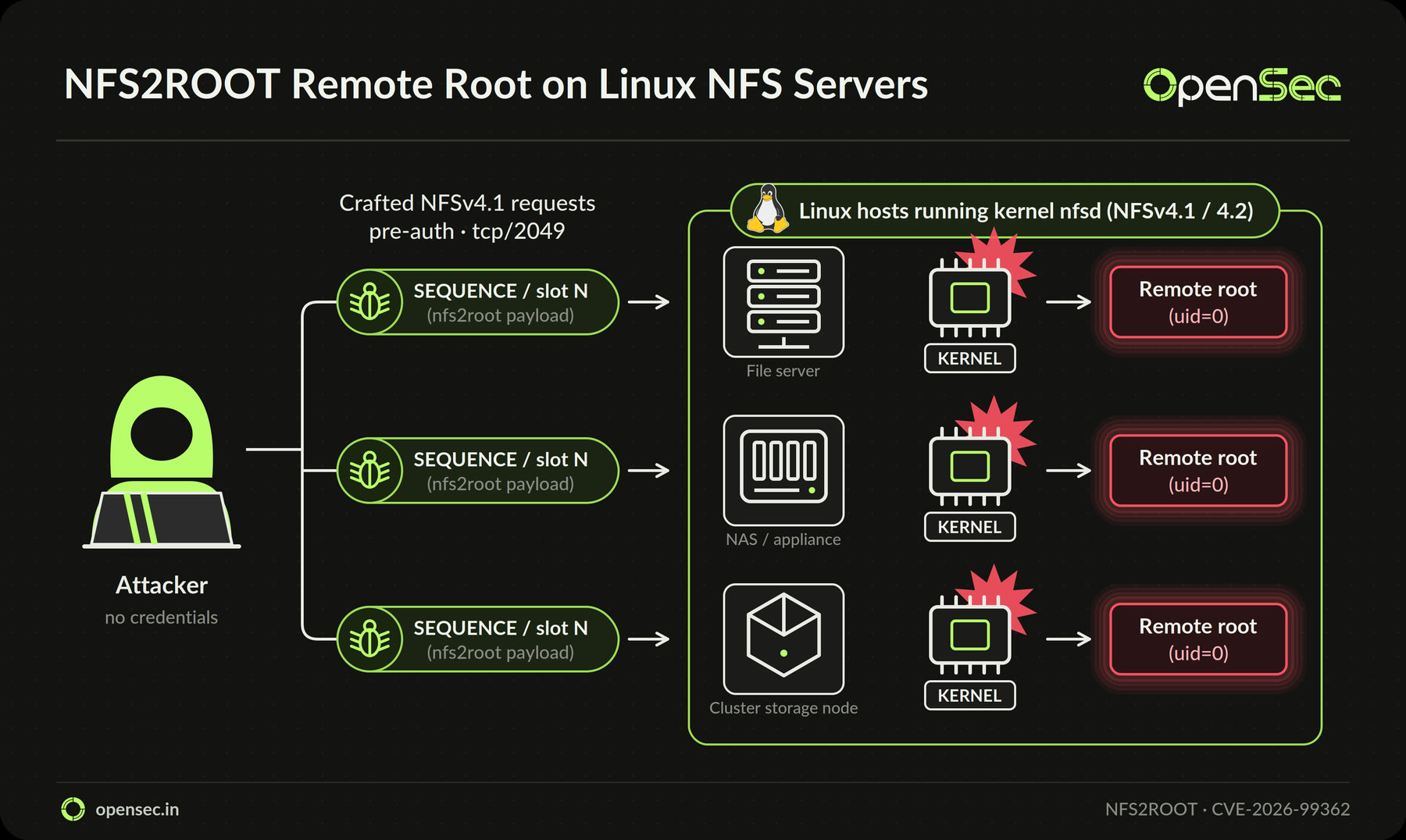
The NFS server runs inside the kernel and parses network input before it knows who you are. CVE-2026-99362 lives in that gap: a client can shrink its reply cache to zero bytes, then make the server copy a full reply into it. The copy lands on the kernel heap, and the client picks most of the bytes.
Twelve years in a few lines of C
Timeline
Commit
47ee52986472narrows the reply buffer while handlingSEQUENCE. It ships in Linux 3.16.12 yearsEvery kernel since 3.16 carries it: LTS, distribution and appliance kernels.
Jérémy Jean of ANSSI sends a fix upstream with a KASAN report.
OpenSec's Antara flags the bug, scores it 9.8 and turns it into a root shell on its own.
CVE-2026-99362 is published with fixes.
Watch it run
A real run, end to end. Left: the victim's console. Right: our client on another machine, talking to the victim only over tcp/2049.
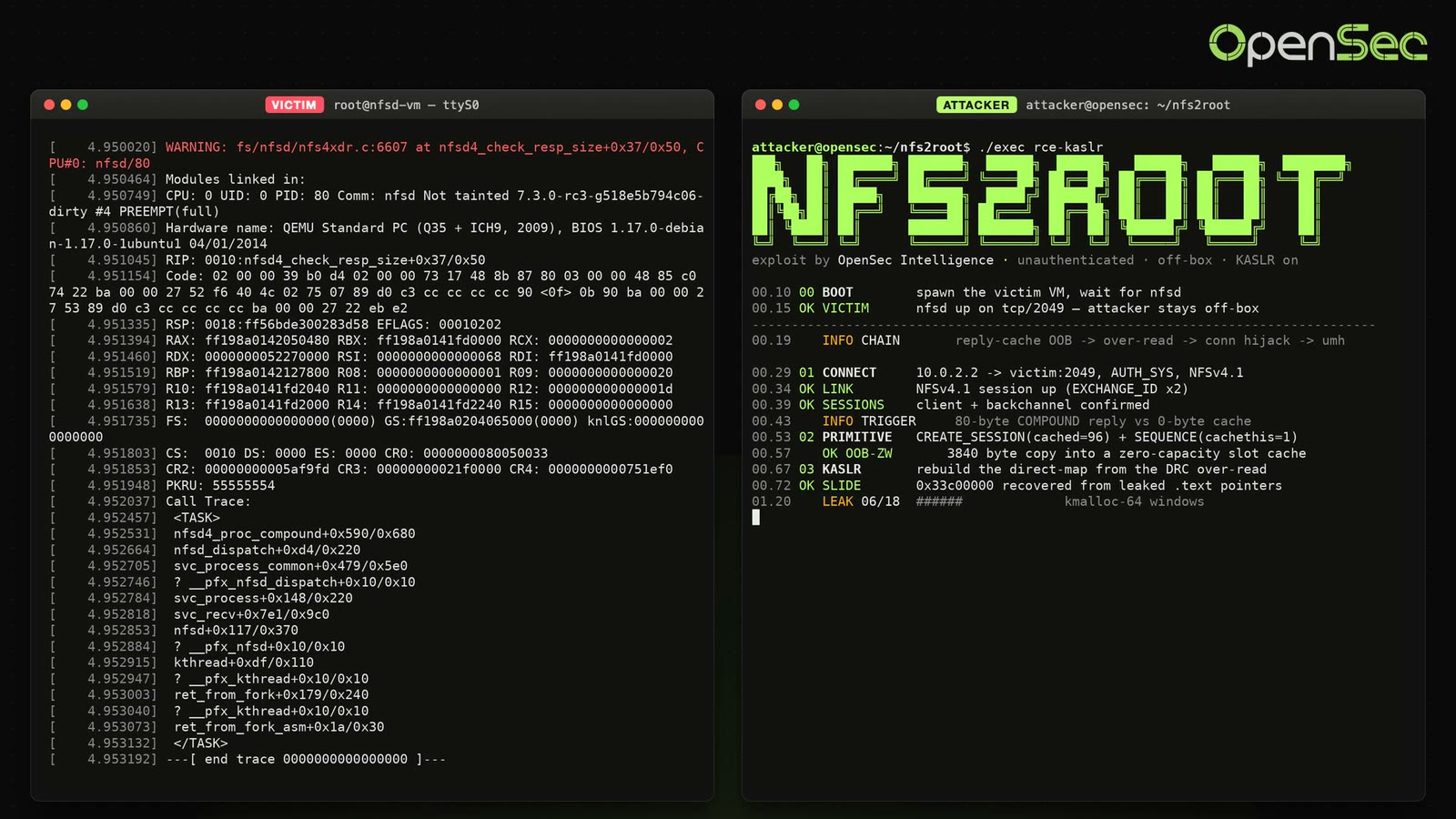
nfsd4_check_resp_size, but the out-of-bounds copy has already happened.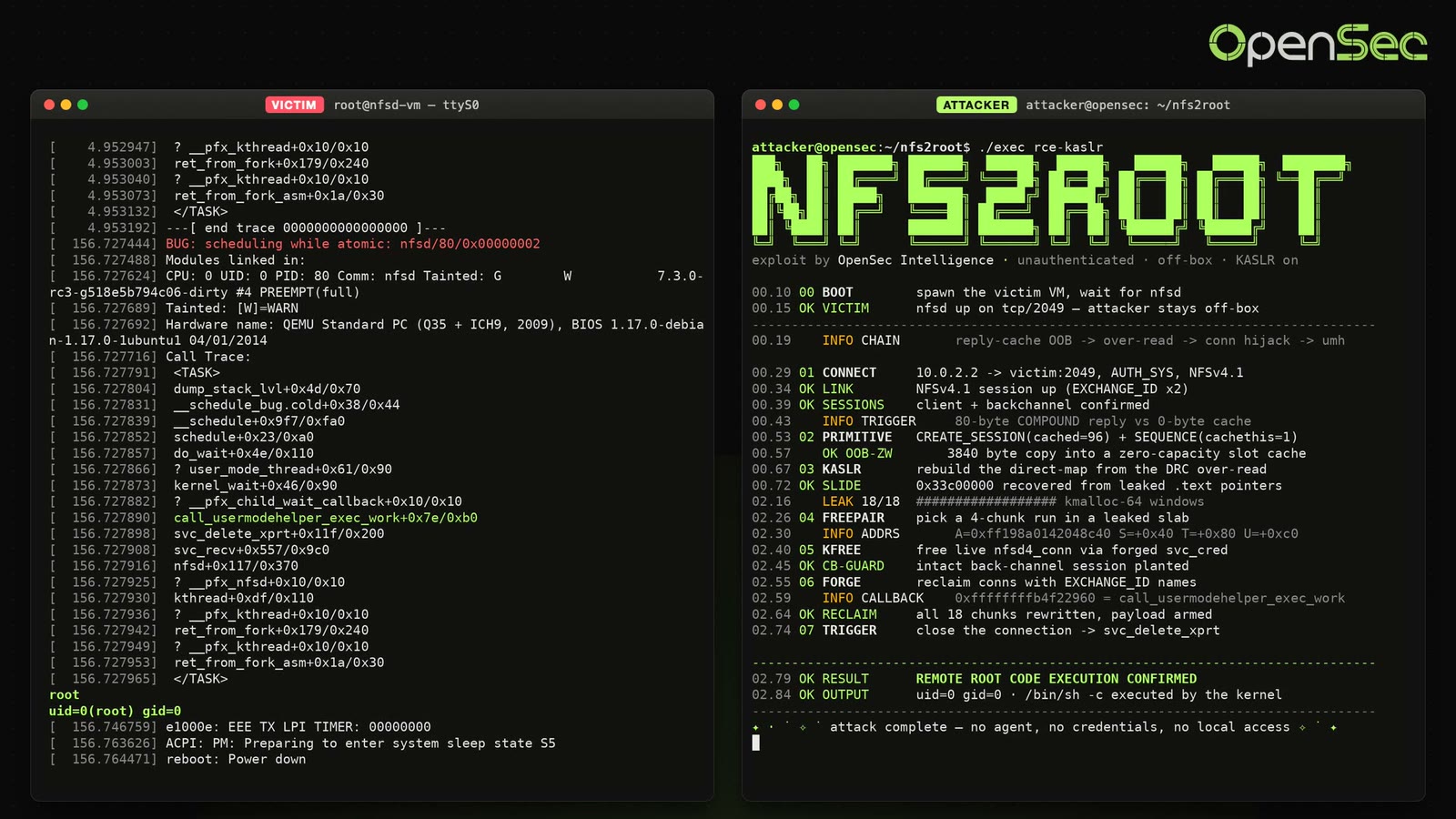
root, then uid=0(root), then power-off.Root cause
Each NFSv4.1 session slot caches its last reply, so a retried request is answered exactly once. The client decides how big that cache is.
Set it to the minimum and every slot's buffer is zero bytes. nfsd4_sequence() then shrinks the reply buffer to that limit before it accepts the slot. Pad the request's tag so the buffer fills right after the SEQUENCE opcode, and the encoder quits without flagging an error. The server believes SEQUENCE succeeded and caches the whole reply, headers and tag included, into a buffer with room for nothing.
BUG: KASAN: slab-out-of-bounds in read_bytes_from_xdr_buf+0x1bc/0x390
Write of size 80 at addr ffff888003a549cd
 __asan_memcpy+0x38/0x60
 read_bytes_from_xdr_buf+0x1bc/0x390
 nfsd4_sequence_done+0x5b0/0x810
 nfs4svc_encode_compoundres+0x1bf/0x240
That is 80 bytes copied, 61 of them past the end of the heap object, 40 of them chosen by the client.
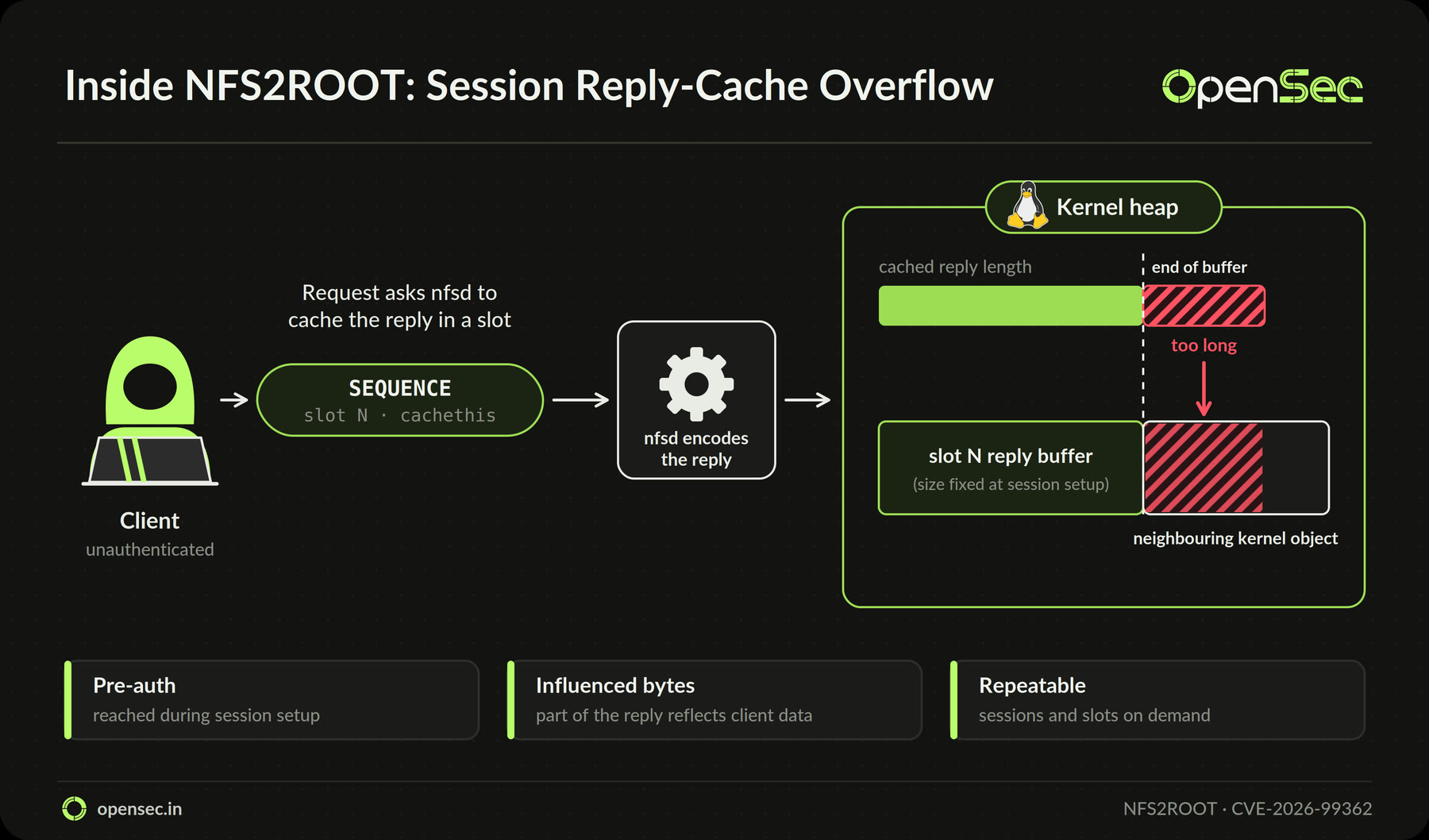
The fix checks that the reply fits before taking the slot, and makes the encoder report what it can't fit.
From overflow to root
The exploit stays private. Each step is an ordinary NFS request:
- Overflow
The write corrupts the neighbouring slot's bookkeeping.
- Leak
A replay request returns 3.8 KB of kernel heap, and with it the KASLR slide.
- Free
A forged pointer makes the kernel free an object we choose.
- Reclaim
We refill that memory with a fake callback built from NFS client names.
- Trigger
We hang up.
nfsdcalls the fake callback, and the kernel runs/bin/shas root.
In the recording, that command is whoami; id; poweroff -f: the victim prints root, then uid=0(root), and switches itself off.
Found and proven by a machine
Antara, OpenSec's white-box harness, flagged the nfsd reply-cache path, scored it 9.8, and built the leak, the arbitrary free and the root shell shown in the video by itself: end to end, with no human in the loop.
Kernel hardening does not remove the overflow. Patch every host.
Am I exposed?
Tick what's true for your host. All four means exposed, today.
Am I exposed?
What to do
Patch and reboot
| Branch | Fixed in |
|---|---|
| 6.12 LTS | 6.12.117 |
| 6.18 | 6.18.61 |
| 7.3 | 7.3.2 |
| mainline | 7.4-rc1 |
On a distribution kernel, install the update that lists CVE-2026-99362.
Can't patch today? Close 2049
nft add rule inet filter input tcp dport 2049 ip saddr != 10.20.0.0/16 dropOr turn off NFSv4.1 and 4.2
[nfsd]
vers4.1=n
vers4.2=n
Then restart nfs-server. This turns off pNFS and some 4.2 features.
Hunting for it
The attack is valid NFS, so there is no network signature. Look for:
- Kernel warnings from
nfsd4_check_resp_size, on every attempt, successful or not. - Oopses with
nfsd4_*,svc_*orcall_usermodehelper*frames. - Shells spawned by kernel workers on a file server.
- Bursts of short NFSv4.1 sessions from one source.
Disclosure
We reported the bug to the NFSD maintainers and security@kernel.org on 22 September 2026 with the full remote-root exploit, and sent a patch the same day. CVE-2026-99362 was published with fixes on 20 November.
Credits
- OpenSec Intelligence: found the bug with Antara, which escalated it to pre-auth root on its own, and reported it with the full exploit and a patch.
- Jérémy Jean (ANSSI): found it independently and wrote the upstream fix,
5d5a72e965c8and241848cc774e. - Chuck Lever and Jeff Layton: the NFSD maintainers.
References
nfsd: preflight SEQUENCE replies before accepting a slotThe upstream fix for CVE-2026-99362, by Jérémy Jean.github.com nfsd: set op->status when an operation's header cannot be encodedThe follow-up guard in the NFSv4 encoder.github.com- Introduced by 47ee52986472 (Linux 3.16)
- Patch thread
- OpenSec's patch submission